
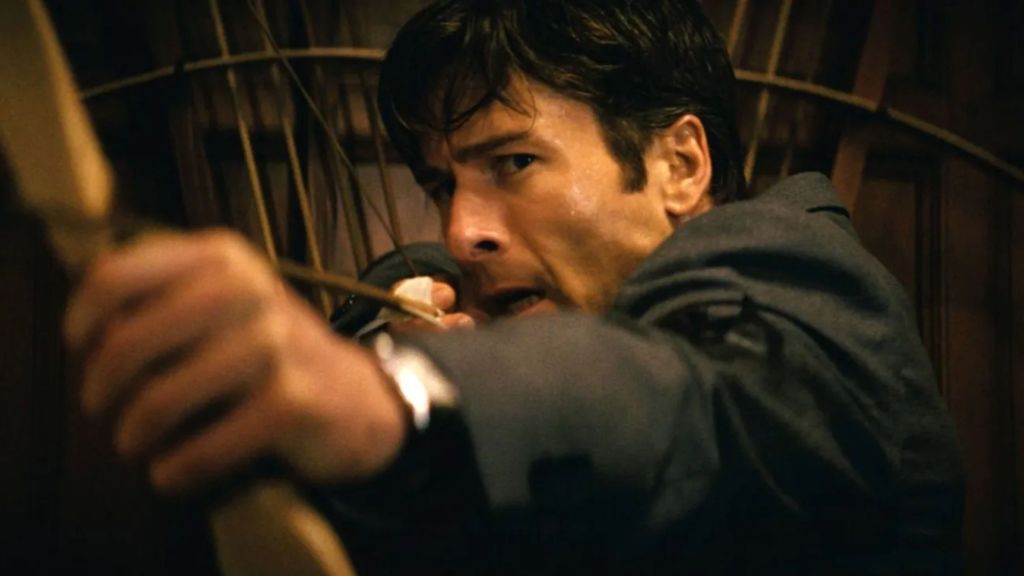
Glen Powell has easily become one of the most in-demand actors working today. Starring in some of the biggest movies of recent years, like Twisters and Top Gun: Maverick, Powell embodies the old-school action hero that filmmakers and audiences are drawn to. Although he’s mainly done big budget action films throughout the decade, his latest effort, How to Make a Killing, sees him in a more dialed back role, but still maintains the charismatic sensibilities that made him the beloved figure he is today.
The film follows Becket Redfellow, played by Powell, a blue-collar worker who lives a quiet life working in a tuxedo shop after being disowned by his wealth-ridden family. After being transferred to a factory position due to nepotism, he begins to hatch a plan to gain his family’s fortune by murdering them one by one, using bizarre accidents as scapegoats. Standing in his way is his mysterious childhood crush, Julia Steinway, played by Margaret Qualley, who disappears and reappears in his life with ulterior motives.
How to Make a Killing plays like a modern American Psycho, following a serial killer willing to put his life on the line to achieve happiness and success. However, the film never paints Becket as a psychopath, instead giving strangely justifiable reasons for him to murder his entire family. Following someone with conflicting, yet resonable always makes for a more compelling cinematic experience, expressing the complexities of humanity and, in this case, how society can shape someone into becoming a serial killer. This storyline has been done multiple times before, but this film shows once again that the formula makes for the perfect moviegoing escapade.

Creating a strong protagonist isn’t solely reliant on the writing; it’s about the performance. There aren’t many actors who could pull off this role as well as Glen Powell, whose quick-witted charm adds the perfect amount of levity for the film, making his sadistic character appear more grounded. His presence makes for an always compelling viewing experience, whether he’s scheming against his family or simply going about his day-to-day activities. The climax demands a wide emotional range as his character undergoes a catharsis, and he portrays this reckoning with a sincere sense of humanity, making it one of Powell’s strongest performances.
The film is not simply a revenge tale; instead, it delves into how classism and mortality can take over a person. It not only points out the flaws in a capitalist society but also shows how someone can become so wrapped up in their own ambitions that they lose their autonomy. This is especially evident in the middle portion of the movie, when Becket chooses to continue with his plan rather than settle for what would likely have been a good life for him. Seeing characters make poor decisions can sometimes feel frustrating, but in How to Make a Killing, you almost feel sorry for Becket as his aspirations consume him negatively. In the film, Becket describes his story as a “tragedy,” and by the end, the weight of that statement comes to fruition in a shockingly satisfying way.

The movie wears its influences on its sleeves, but sometimes, it does so to a fault. There are very few surprises in How to Make a Killing, which tells a mostly standard tale of one’s uprising. Knowing just the concept, it is extremely easy to see where the film will go, despite a couple of minor twists. Despite its complex protagonist, the story stays fairly surface-level in its themes, failing to offer a new perspective on the struggles of capitalist society. While films don’t always have to bring new ideas to their subject matter, a film this straightforward needed something else to make it stand out.
Advertised as a crime comedy, it is shocking how little the comedy was utilized. While there are moments in the editing that convey an awkward style of humor, and Glen Powell is naturally funny, there wasn’t nearly enough comedy. Most of the comedy came from the always-reliable Zach Woods, whose dry delivery as Noah Redfellow made for many standout moments. For a movie focused on accidental deaths, it severely underutilized its comedic potential. Instead of satirical deaths that could’ve matched the character’s fatal flaws, they’re the most drab and uninspired ways to kill someone, leaving many scenes disappointing.
How to Make a Killing is the exact film the trailer sold: a fun, breezy crime thriller with a compelling lead performance from Glen Powell. Those expecting or wanting more than that will likely be disappointed, but as someone who’s always eager for the new Powell flick, this delivered exactly what I wanted. Writer/director John Patton Ford once again proves to be a reliable filmmaker when it comes to the crime genre, and if this is the kind of film they make for the rest of their life, I wouldn’t be opposed.
How to Make a Killing will release in theaters nationwide on February 20.
Rating: 6/10
Oscar Prospects:
None.



 Reel Recommendation
Leave a reply to Lisa or Li Cancel reply