

Richard Linklater has one of the fastest work rates of any filmmaker working today. Releasing seven films in the span of ten years, as well as working on a 20-year passion project, Merrily We Roll Along, only a select few filmmakers are putting out films at the rate of Linklater. His upcoming project, Blue Moon, is one of two films that he is set to release in 2025, with this film starring longtime collaborator Ethan Hawke.
Blue Moon follows real-life songwriter Lorenz Hart(Hawke), a depressed alcoholic who finds his life fading away after experiencing the opening night of Oklahoma!, which he predicts will be a huge success. Taking place almost entirely during an afterparty at a restaurant bar, Lorenz expresses his frustrations with the play toward the bar workers and his longtime collaborator and creator of Oklahoma! Richard Rodgers, played by Andrew Scott.
Opening with Lorenz’s death sets the perfect tone for Blue Moon. His death occurs relatively quickly, almost comedically, to throw the audience off in the film’s storytelling. The film has a playful vibe to it(a Richard Linklater staple). Still, it is also rooted in an inherent sadness, conveying ideas of morality and the trajectory of the future in a highly accessible yet emotional manner. Beginning the film this way sets the stage for what’s to come in an unexpectedly satisfying way.
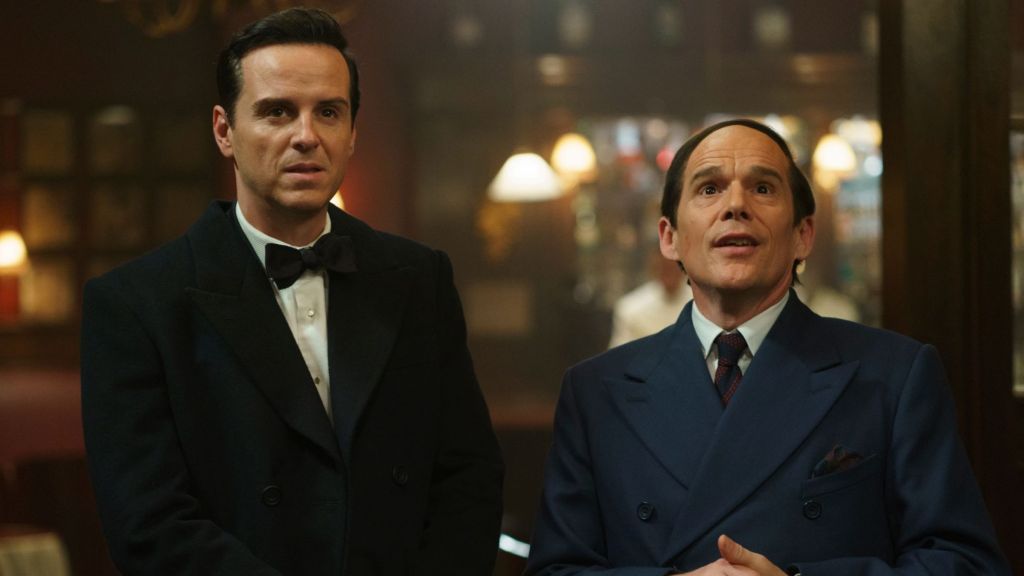
Lorenz Hart is in nearly every frame of Blue Moon. Despite his diminutive 5-foot stature, Hart has a huge presence, with his quick wit and flamboyant persona bringing a spotlight to any room he enters. It would be challenging to play a figure filled with this much personality, but Ethan Hawke makes it look easy in what is easily his best performance in years. Hawke captures Lorenz’s quirks in a faithful yet accessible manner. Despite taking place in one location, Lorenz goes through an array of emotional breakthroughs that convey exactly who Lorenz was while expressing other grand and universal themes.
Blue Moon plays mainly as a bar comedy, especially in the beginning sequences. Seeing Lorenz complain about Oklahoma! and the Broadway industry during the 40s made for numerous hilarious moments, especially for die-hard theater lovers. The film acts as a Marvel movie for theater fans, littered with references and character appearances that will have audiences pointing at the screen like Leonardo DiCaprio in Once Upon a Time… In Hollywood. From character inclusions like Oscar Hammerstein II and Steven Sondheim to stage-like cinematography, the film perfectly captures its love for Broadway in a way that even unfamiliar fans could enjoy.
The film also plays as an ode to classic Hollywood filmmaking. The characters mention Casablanca multiple times in the film, expressing their love for the film and for specific sequences and quotes that stood out to them. Not only do the characters blatantly recall elements of Casablanca, but the structure of Blue Moon repeats many aspects of the beloved classic. From its simultaneously bleak and satisfying ending to its subplot about a forbidden romance, Linklater’s love for Casablanca and older Hollywood filmmaking is sprinkled throughout the film.
Lorenz is highly critical of Oklahoma! throughout the film, stating that although it has pizazz and will likely be one of the biggest Broadway shows in history, it lacks the thought-provoking nature that makes it true art. He parallels the show to his hit song “Blue Moon,” which is far from his favorite but stands as his most popular. Richard Linklater uses this as the crux of the film, not only showing how Lorenz felt later in his life, but also how Linklater views his career and making films. Making films will always be risky: ones that may not seem like successes may turn out to be bigger than anyone could imagine, and vice versa. Even if that one successful film is shallow compared to other projects, the fact that it made such an impact on the audience makes it as much art as any other film, and this idea is expressed perfectly in Blue Moon.

Significantly dialogue-centric, Blue Moon sometimes overdoes it with the references and cameos of other artists. The main culprit of this is the inclusion of E. B. White. Although Lorenz played a pivotal role in the creation of White’s most significant projects, these sequences didn’t add much to the film’s overall narrative, instead coming off as winks to the camera.
Despite some minor shortcomings, Blue Moon remains an excellent film that explores themes of legacy and storytelling in a highly accessible manner. Linklater somehow makes a loose biopic into something universal for audiences. The fact that Linklater is still able to tell original tales after decades of original storytelling shows just how strong a filmmaker he is, and how audiences should always anticipate what he does next.
Blue Moon played as a Special Presentation at the 2025 Heartland International Film Festival. It is now playing in select theaters around the country.
Rating: 7/10
Oscar Prospects:
Best Actor



 Reel Recommendation
Leave a reply to My Predictions for the 2026 Academy Awards – Reel Recommendation Cancel reply