

Edgar Wright has become one of the defining directors of this century. With films like Scott Pilgrim vs. the World and Shaun of the Dead becoming instant classics in their respective genres, Wright’s releases are worldwide events. Teaming up with Glen Powell to remake a classic Stephen King novel, The Running Man was a title to look out for upon its initial announcement.
Set in a dystopian future, the film follows Ben Richards (Powell), a man who enters The Running Man, a game show, to earn enough money to care for his sick child. To win the game, he must survive for 30 days without being killed by a slew of hunters. Constantly being watched by drones and other audience members hoping to participate in the games, Ben must rely on his wits and survival instincts in order to provide a stable life for his family.
Edgar Wright’s depiction of The Running Man is vastly different from the 1987 film starring Arnold Schwartzeneggar. Instead of taking place in the confines of a rundown town, Wright’s adaptation is much more faithful to the original source material, with a far more expansive setting and massive ensemble. Ben Richards’ backstory is also entirely different from the other film, with Schwartzneggar’s version having him forced to play the game with no care for earning the prize money. While most remakes fail to justify their existence, Wright’s attempt to develop a more accurate version of the Stephen King novel did more than enough to prove itself worthy of another theatrical treatment.

Playing a role after someone as iconic as Arnold Schwartzneggar portrayed the character is a lot for the actor next in line, but Powell arguably does a better job, providing the character with much more complexity. Instead of being a character thrust into a terrible situation, Powell’s Ben Richards chooses to be where he is, making for a far more compelling character. Powell has proven in films such as Hit Man and Twister that he has more than enough charm to lead a Hollywood blockbuster, but his work in The Running Man once again showcases his range. Possibly his angriest and grittiest performance yet, Powell turns a bizarre character into someone easy to root for, showcasing his strengths and flaws in an extremely organic way. When it comes to a sci-fi/action character as iconic as Ben Richards, there aren’t many actors who could improve upon what Powell brought to the role.
The film is extremely heavy-handed in its depiction of its authoritarian government, but cleverly uses humor to deliver it. From Powell’s loud, aggressive reactions to the situations he finds himself in to the outlandish advertisements during the airing of The Running Man, the movie uses humor to bring a sense of positivity to its otherwise depressing setting. For a film that sees humans risk their lives doing insane tasks just to make it by in life could be interpreted in an exceedingly melancholic way, but Wright strikes the right balance of fun and horror.
The fast-paced nature of Wright’s film carries over in The Running Man, but lacks his other signature qualities that make him such a renowned filmmaker. The editing and sound design usually play a pivotal role in creating a rhythm for his films, but this one is sadly lacking in these areas, mostly coming across as invisible. The film also lacks a strong visual language, with production and costume design doing most of the work to make it pop, rather than the framing. Even Wright’s less critically acclaimed films, like Last Night in Soho, used sound, editing, and cinematography in interesting ways, and to see it absent in his most recent film is very disappointing.
The film’s structure is also lacking, rushing in moments that needed more development. The movie immediately starts out with Powell attempting to join the game, with only a brief conversation with an old boss and his wife preceding the scene. For a film set in a dystopian time, it is integral to allow the audience to fully grasp the setting and overall environment, but The Running Man does a poor job of this. There are also times when Wright’s fast pace gets the better of him, skimming through sequences in a montage-like form that doesn’t give the audience enough time to take in specific sequences.
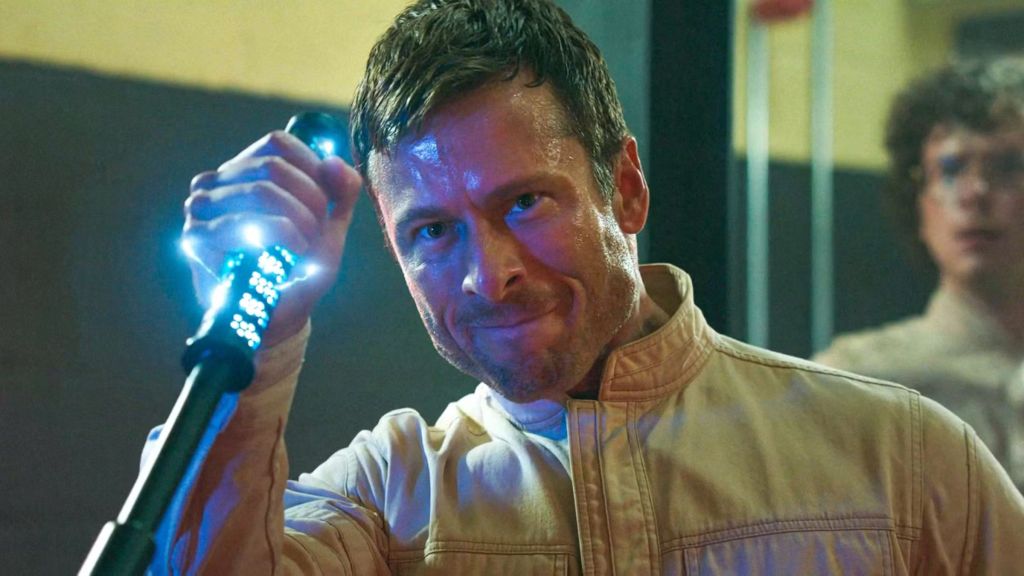
The ending lacks the major punch necessary for a film delving into the takedown of an authoritarian society. The film is built around Ben attempting to take down society so he and others in his social class can become free, and by the time his arc concludes, it does so especially quickly, lacking the emotional release needed for a satisfying experience. While the ending offers some elements of inspiration that the audience can take away, it wasn’t nearly as effective as it should’ve been.
Each character Ben interacts with is meant to represent how society has shaped their worldview, but the fast pace doesn’t allow these ideas to fully flesh out. Michael Cera is hilarious as Elton Parrakis, a paranoid rebel, but his scenes mostly serve comedy rather than offering anything intellectually worthwhile. Emilia Jones’ role as Amelia Williams is entirely wasted. Initially, a thought-provoking portrayal of the upper class failing to comprehend the issues faced by the lower class, she is disappointingly reduced to a damsel in distress. Although there was a clear reason to include these characters in the overall story, the script didn’t allow them to reach their full potential.
Far from Wright’s best work, there are still plenty of fun thrills and humor that make this adaptation worthy of the big screen treatment. With a charming lead performance from Glen Powell and a compelling premise that ties too close to our current world, The Running Man does just enough in its 133-minute runtime to make it worth recommending. This isn’t a movie you need to run to see, but maybe a brisk walk.
The Running Man is now playing in theaters nationwide.
Rating: 6/10
Oscar Prospects:
None


 Reel Recommendation
Leave a comment